Concept · Foundations
How the Eye Sees Color
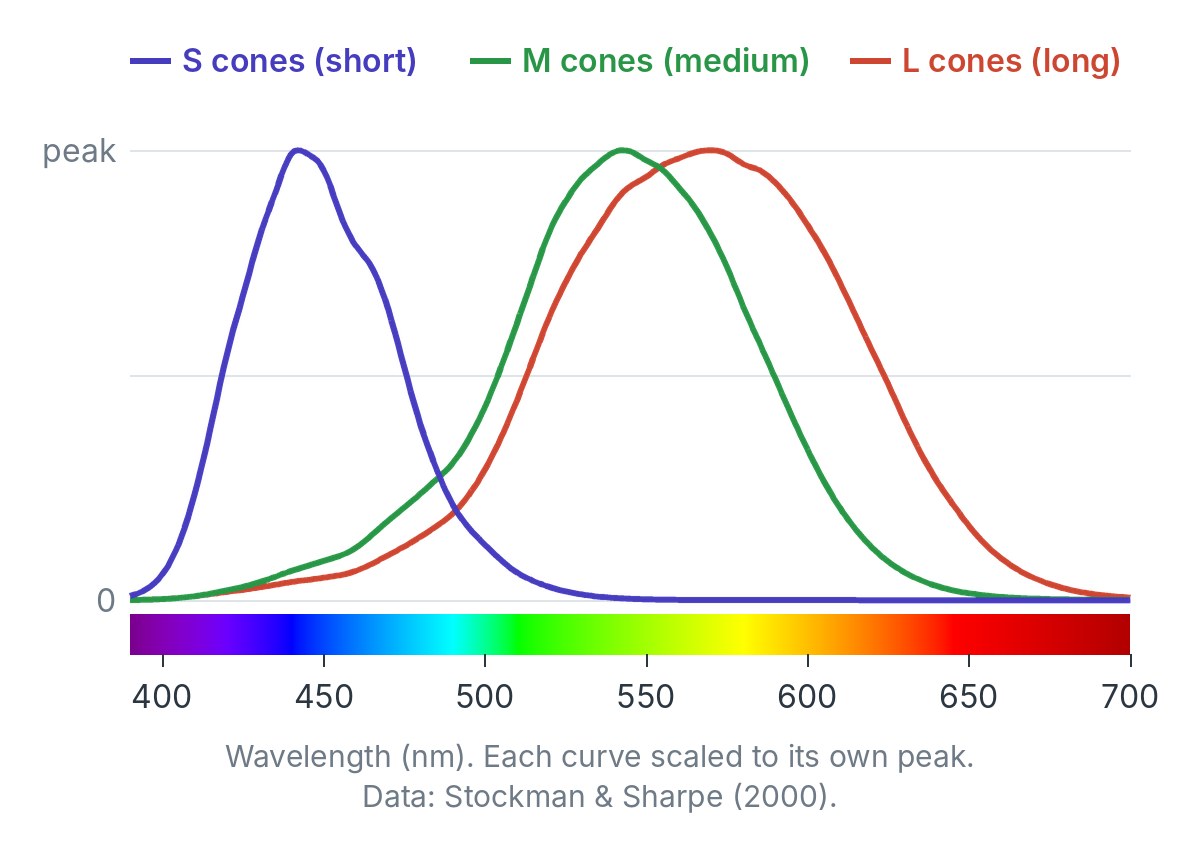
Color vision starts with three kinds of cone cell in the retina, most sensitive to short, medium or long wavelengths; nerve cells, beginning in the retina itself, then compare their signals.
The three ranges overlap widely, so no single cone signals red or blue; color comes from the balance among them. That is why three lights can be mixed to match a huge range of colors.
- Watch a garden at dusk: as cones give way to the more sensitive rods, colors fade before shapes do.
- Color is seen most sharply at the center of gaze, where cones are packed most densely.
- The eye's lens yellows with age, absorbing more of the shortest, blue-violet wavelengths before they reach the cones.
- Retina
- The light-sensitive layer lining the back of the eye.
Image: Made for this site · Original work