Concept · Foundations
Light Changes Color
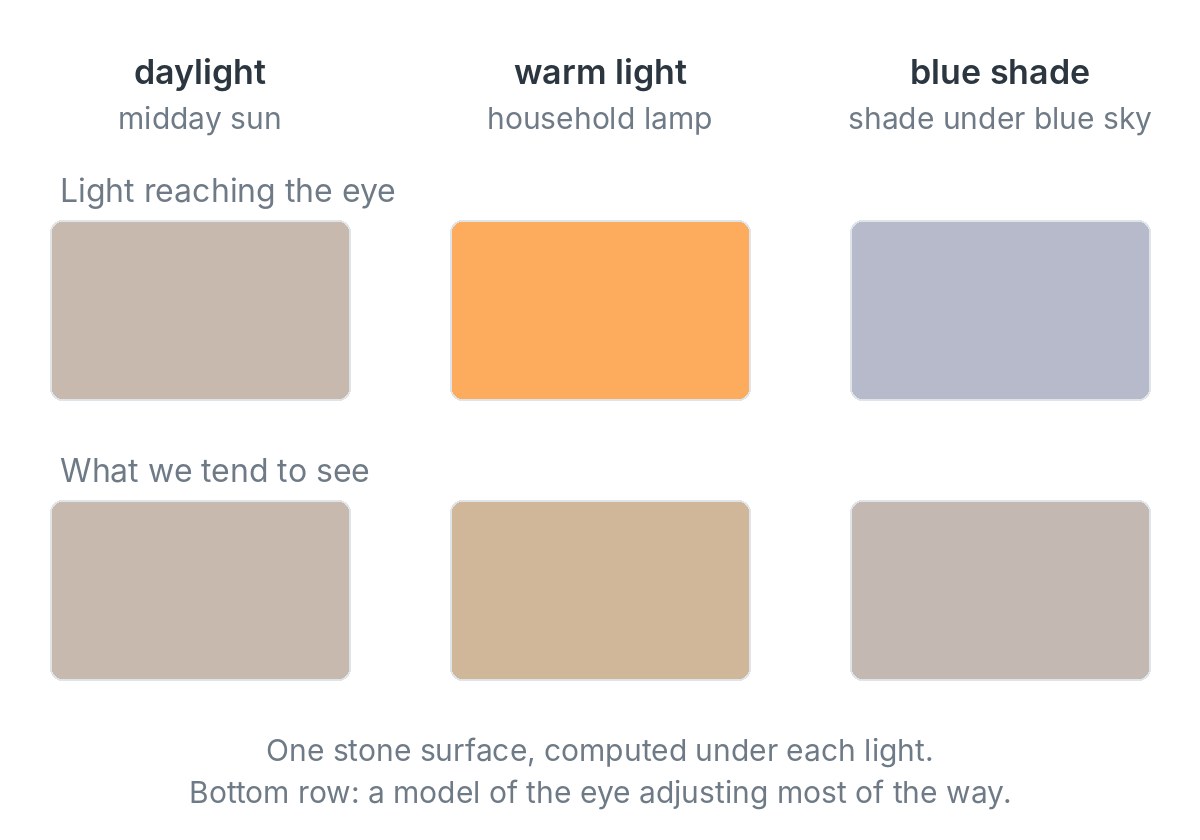
Color constancy is the brain's habit of seeing roughly a surface's own color even when the light falling on it, and so the light it sends to the eye, changes.
Lamplight is rich in long wavelengths, so a gray stone under it really does send orange-tinted light to the eye; blue shade does the reverse. The brain discounts the tint by judging each color against the whole scene.
- Look at a white wall lit by a lamp at one end and daylight at the other; the ends differ.
- Painters chasing a particular light paint the shift the brain hides, sometimes pushing it further; Monet's cathedral series is one example.
- Constancy is incomplete: in strongly colored light, or in a patch seen out of context, the tint shows.
See
Image: Made for this site · Original work