History · Foundations
Goethe and the Seeing Eye
Johann Wolfgang von Goethe's Zur Farbenlehre (Theory of Colours, 1810) treated color as something that happens in the viewer's eye, not only in light.
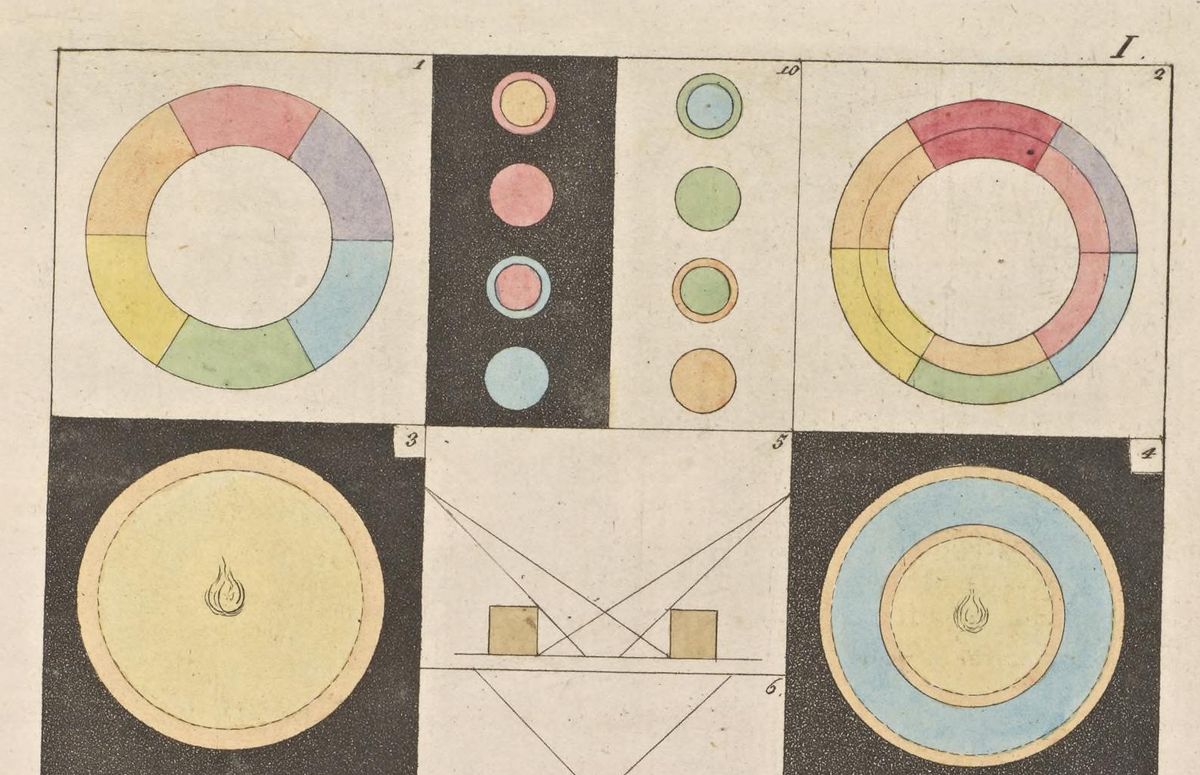
He opened with colors the eye produces itself, such as afterimages and colored shadows, which, he complained, earlier writers had treated as illusions. His six-part ring sets each color across from a partner. His English translator judged that the open attack on Newton kept many scientists from hearing him out, at least for a time.
- In the ring, yellow faces violet, orange faces blue and red faces green.
- Partners, in the 1840 translation, “reciprocally evoke each other in the eye”; see Afterimages, in the module on interaction.
- That translator, Charles Eastlake of the Royal Academy, first meant to publish only the parts useful to painters.
Image: Getty Research Institute via Internet Archive · Public domain