History · Foundations
Newton Splits White Light
In Opticks (1704), Isaac Newton published his account of a prism spreading sunlight into a band of colors that can be gathered back into white.
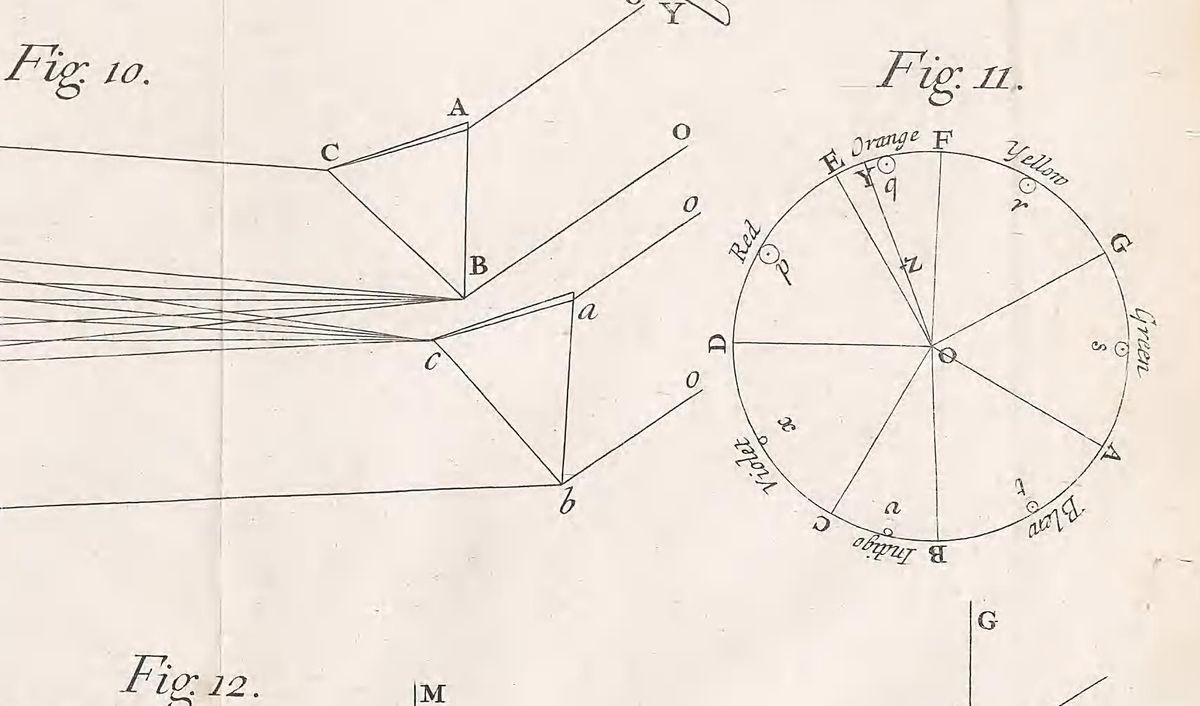
He bent the band into a circle, sizing each color's arc like a step in a musical scale. Treating the colors in a mix of lights as weights on the ring, he proposed that the closer their balance point lay to the center, the whiter the mix.
- On the plate the arcs read red, orange, yellow, green, blue (spelled “Blew”), indigo and violet.
- Color, he wrote, lies in how surfaces reflect rays and rays stir the senses: “the rays to speak properly are not coloured” (1704).
- He admitted a gap: two opposite colors alone had not yet given him true white, only a faint tint.
Image: Smithsonian Libraries via Internet Archive · Public domain