Concept · Foundations
The Color Wheel
A color wheel arranges hues in a closed ring, running from red through violet and back to red, so every hue has neighbors on both sides.
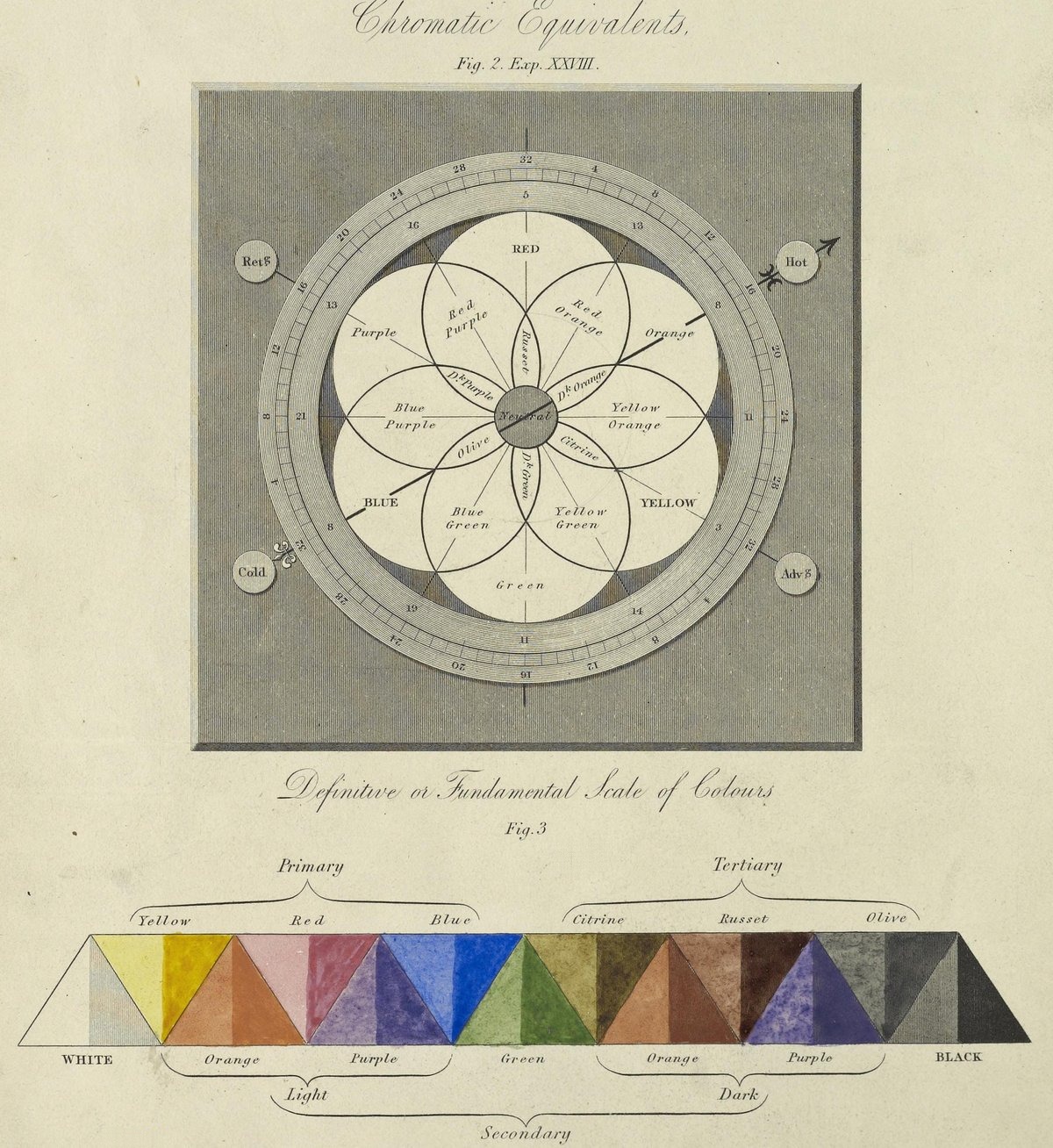
On the painter's traditional wheel, red, yellow and blue are the primaries. Two primaries mixed give a secondary: orange, green or violet. A primary mixed with the secondary beside it gives a tertiary, such as blue-green. Twelve steps are usual; finer wheels are possible.
- Read it as a map of mixing; Analogous, in the module on harmony and contrast, covers how neighbors mix.
- This wheel follows paint; light and printing ink start from other primaries (see Mixing Light vs. Mixing Paint).
- George Field's 1835 tertiaries mix two secondaries: citrine, russet, olive. Today's are also called intermediates.
Image: Getty Research Institute via Internet Archive · Public domain