Concept · Foundations
Hue, Value and Saturation
Every color has three properties: hue, its color family (red, blue-green); value, how light or dark it is; and saturation, how strong or grayed it is.
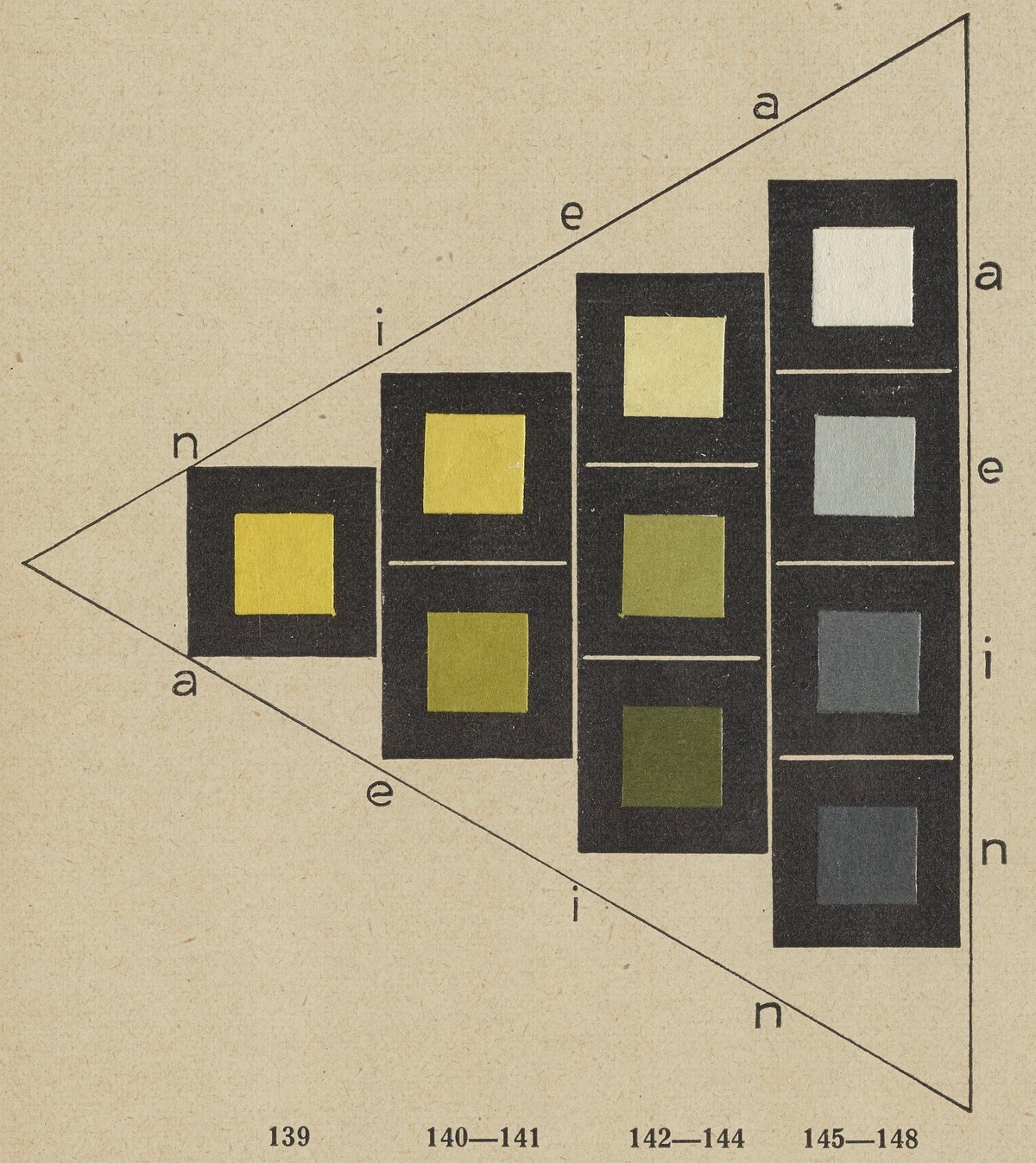
Each can change while the others hold still. The chemist Wilhelm Ostwald's 1921 triangle starts from one yellow: mixed toward white it makes tints along the top edge, toward black shades along the bottom, and toward gray the tones between. All three usually also lower saturation.
- Name a color by all three, such as a light, grayed blue-green, rather than by an object like sage.
- Black shifts hue as well as value: stirred into yellow, it gives olive greens.
Image: Science History Institute Digital Collections · Public domain