Dream, Decoration and the Wider World
Edvard Munch
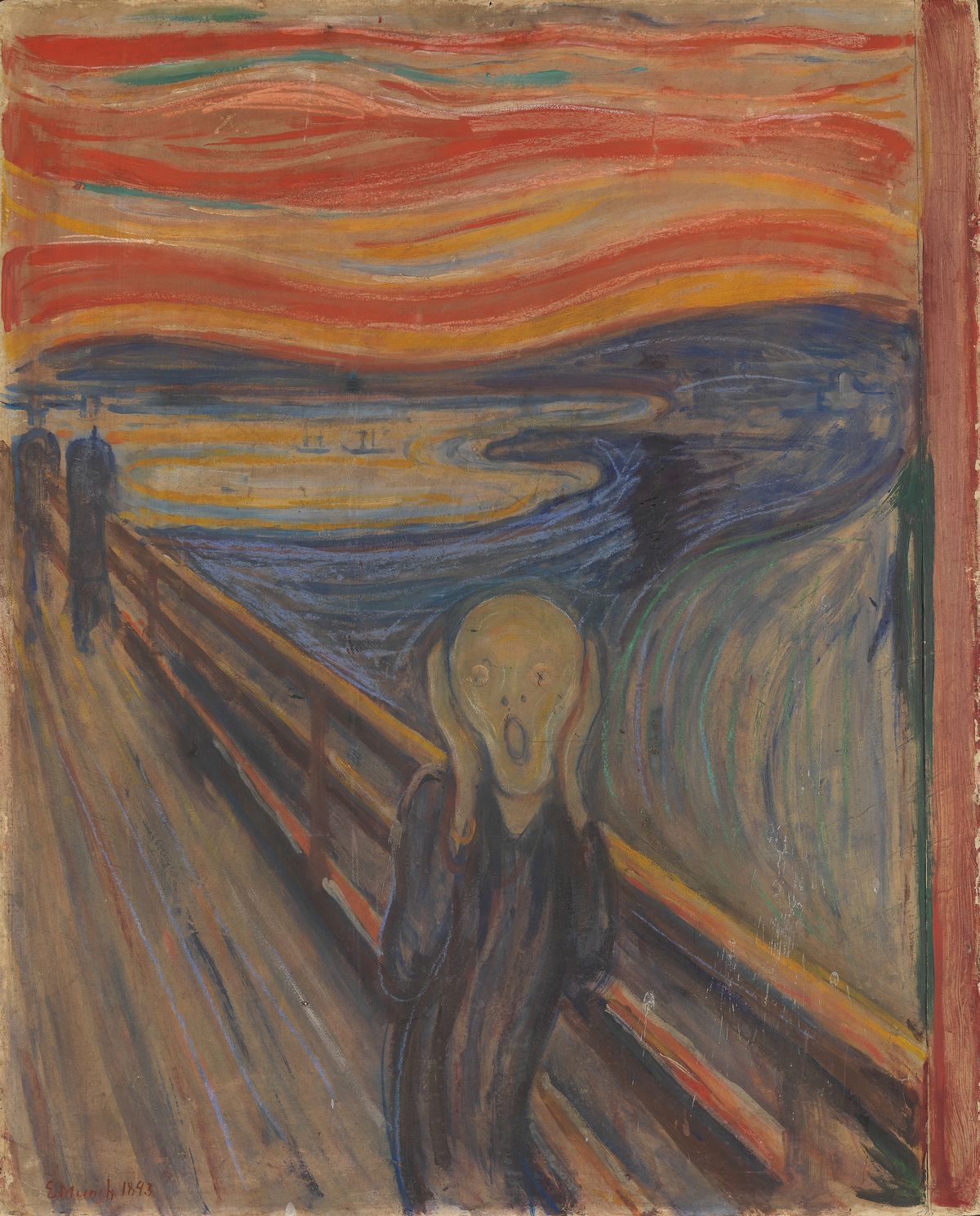
The Scream
1893
Tempera and oil crayon on cardboard, 91 × 73.5 cm. Nasjonalmuseet, Oslo
A figure with a skull-like face clutches its head on a road above a fjord. It became a lasting image of modern anxiety.
- Sky and water bend into swirling bands that echo the figure's panic. Feeling reshapes the landscape, one reason it is widely read as a turn toward Expressionism.
- It was first shown in Berlin, under the title Despair.
- Look for faint pencil writing at top left, claiming only a madman could paint it.
- An 1892 version showed a clearly drawn man; here he shrinks to a schematic face.
- Collector Olaf Schou gave it to the national collection in 1910.
A figure without age or identity invites viewers' own fears. Other versions include a painting at MUNCH, two pastels (1893, 1895) and an 1895 lithograph.
- Expressionism
- Art that distorts form and color to convey inner feeling rather than outward appearance.
Image: Wikimedia Commons · PD-Art