Color as Feeling
Gauguin, Pont-Aven and Synthetism
Brittany, then Tahiti: flat color and dark contour put to work for belief and dream.
In Brittany in the late 1880s, Gauguin and younger painters traded observed light for flat color, firm outlines and images of belief. Their ideas spread through friendships, a café exhibition and one small panel. In Tahiti, he carried the method into pictures of a colonial society assembled from borrowed sources.
- The Pont-Aven circle: Gauguin, Bernard and Sérusier in Brittany
- Self-portraits, a ceramic and a talisman that launched the Nabis
- Tahiti: paintings and prints built from many cultures, read with their colonial context
- Synthetism
- The Pont-Aven style of simplified drawing, firm contours and flat, intense color, often painted from memory.
Works in this part
- Madeleine in the Bois d'Amour
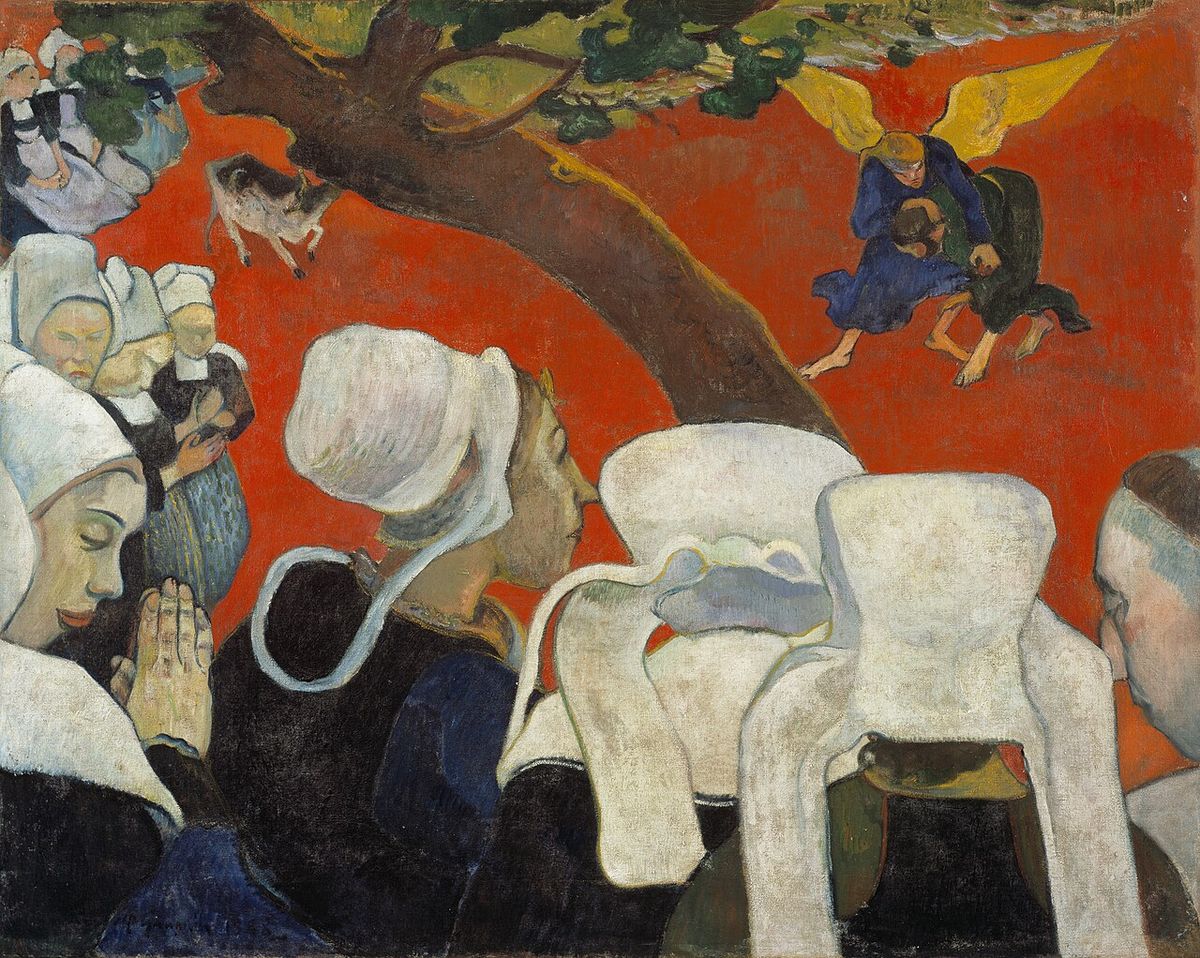
- Vision of the Sermon (Jacob Wrestling with the Angel)
- Self-Portrait with Portrait of Emile Bernard (Les Misérables)
- The Talisman (Landscape in the Bois d'Amour)
- Self-Portrait in the Form of a Grotesque Head (Pot anthropomorphe)
- The Yellow Christ
- The Seaweed Gatherer
- Ia Orana Maria (Hail Mary)
- Merahi metua no Tehamana (Tehamana Has Many Parents)
- Nave Nave Fenua (Delightful Land)
- Where Do We Come From? What Are We? Where Are We Going?
Image: Wikimedia Commons · PD-Art