Concept · Relationships
Triads and Wider Schemes
Wider schemes space three or four hues around the color wheel.
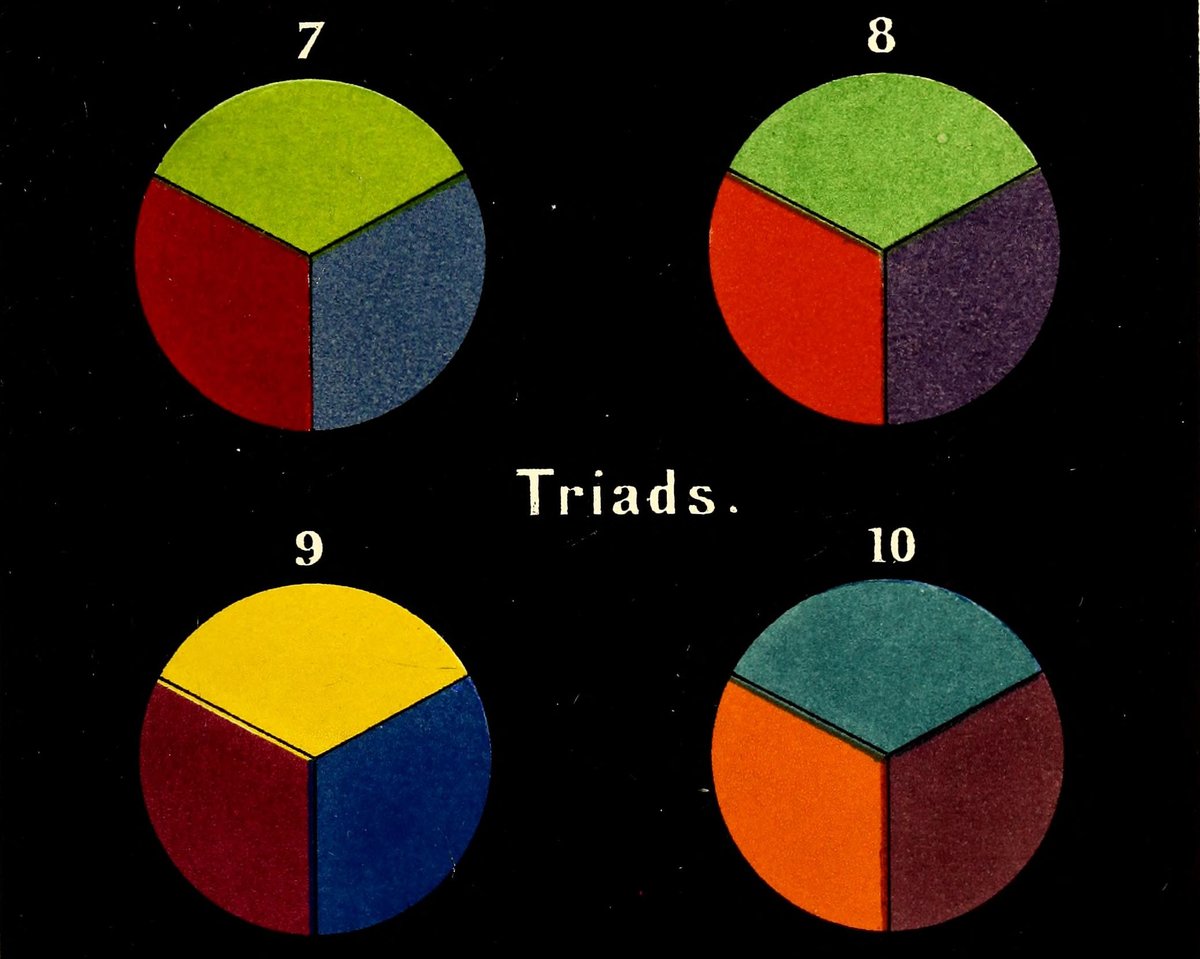
A triad takes three evenly spaced hues, as in Bezold's four 1876 examples, spaced on his own twelve-step circle. A split complement pairs one hue with the two neighbors of its opposite, and a square takes four evenly spaced hues. These schemes are lively but hard to balance, so most painters let one hue lead and keep the others smaller or duller.
- To spot a triad, name a picture's three main colors and check their spacing on the wheel.
- A split complement gives much of the punch of opposites with less of a head-on clash.
- Three or four distant hues at full strength and equal size compete and look like a flag.
See
Image: Smithsonian Libraries via Internet Archive · Public domain