Concept · Relationships
Seeing Light and Dark
A painting's value pattern is the arrangement of its lights and darks, and it does more than hue to show form, light and depth.
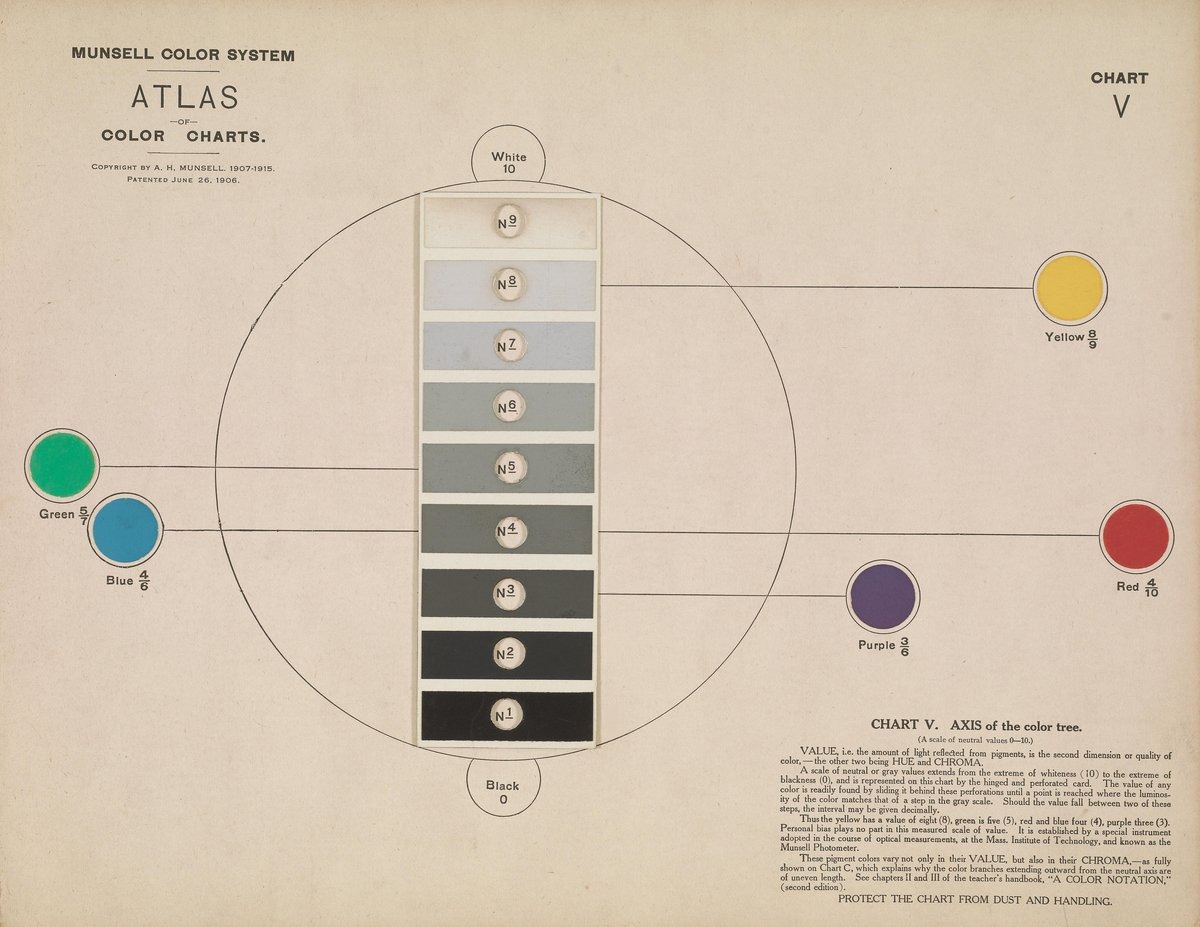
Every hue has its own value at full strength: on Munsell's 1915 chart, yellow sits at 8 of 10, red and blue at 4, purple at 3. The brain reads depth and form largely from differences in lightness, so a well-built picture still holds together in a black-and-white photograph.
- Squint: it blurs detail and mutes hue, so the main lights and darks stand out.
- Many painters plan a picture in three to five values before they choose any colors.
- Strong hues mislead the eye; a vivid red can look lighter than a gray of the same value.
See
Image: Smithsonian Libraries via Internet Archive · Public domain