Revolution and Nightmare
Francisco de Goya
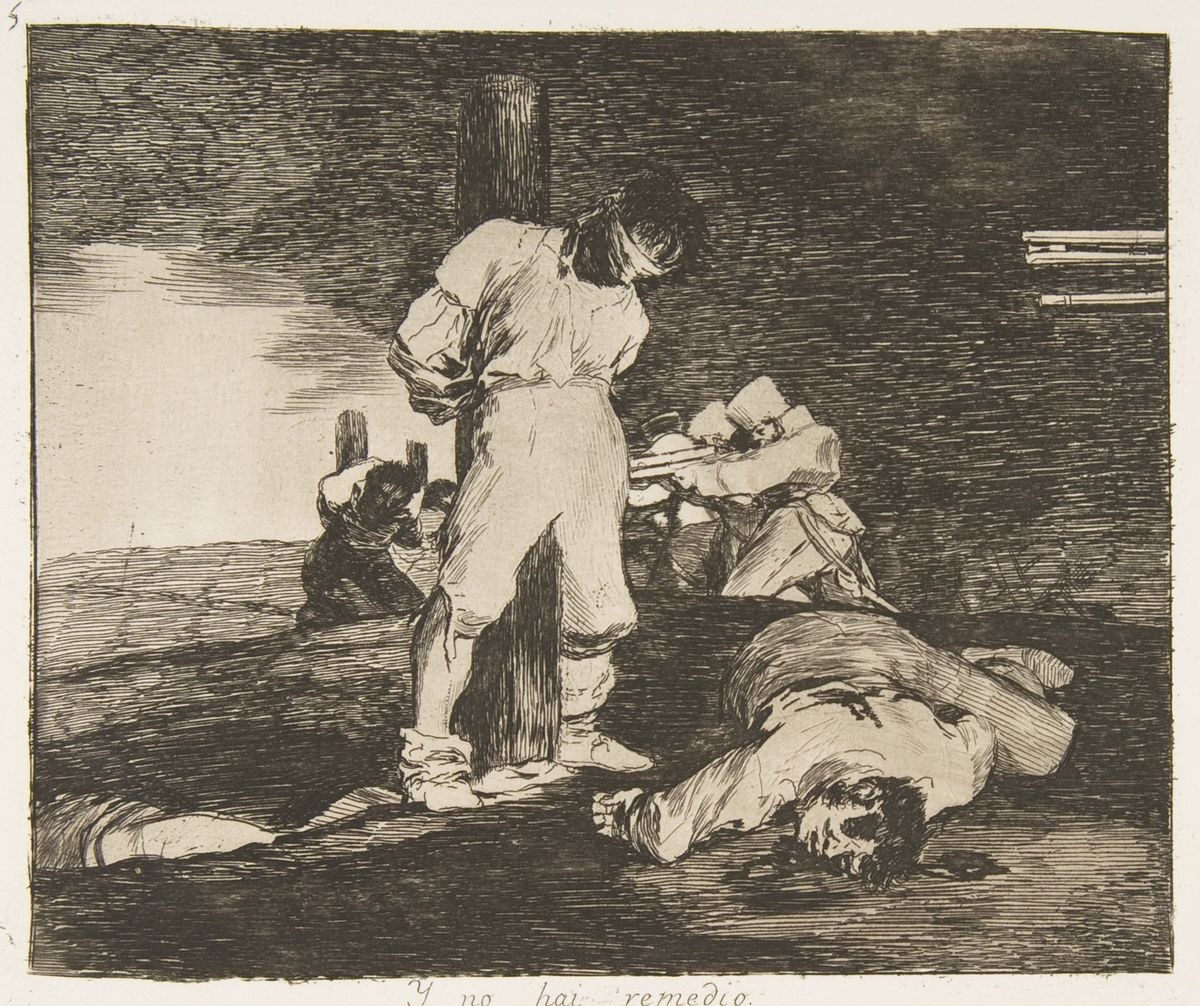
And There Is Nothing to Be Done (Y no hai remedio)
1810, published 1863
Etching, drypoint, burin and burnisher; plate 14 × 16.6 cm. The Metropolitan Museum of Art, New York
Two bodies lie in front, a firing squad shoots other prisoners behind, and a blindfolded man bound to a post waits his turn. The Met reads it as several moments of one execution in a single scene.
- Plate 15 of the Disasters of War; the Real Academia de San Fernando published the first edition long after his death.
- Look at the three rifle barrels poking in from beyond the right edge, held by shooters we never see.
- The Met notes it was etched on the back of a plate already used for a landscape print.
- Killing appears as cold routine, seen low and close among the dead and the next to die: war from the victims' side. Ilchman (MFA Boston) contrasts Jacques Callot's 1633 war prints, which keep such brutality at a distance.
- Given to the Met by Mrs. Grafton H. Pyne in 1951.
Image: The Met Open Access · CC0