Beginnings
Before 1874: The Salon, Realism and Manet
What the Impressionists rejected, and what they took
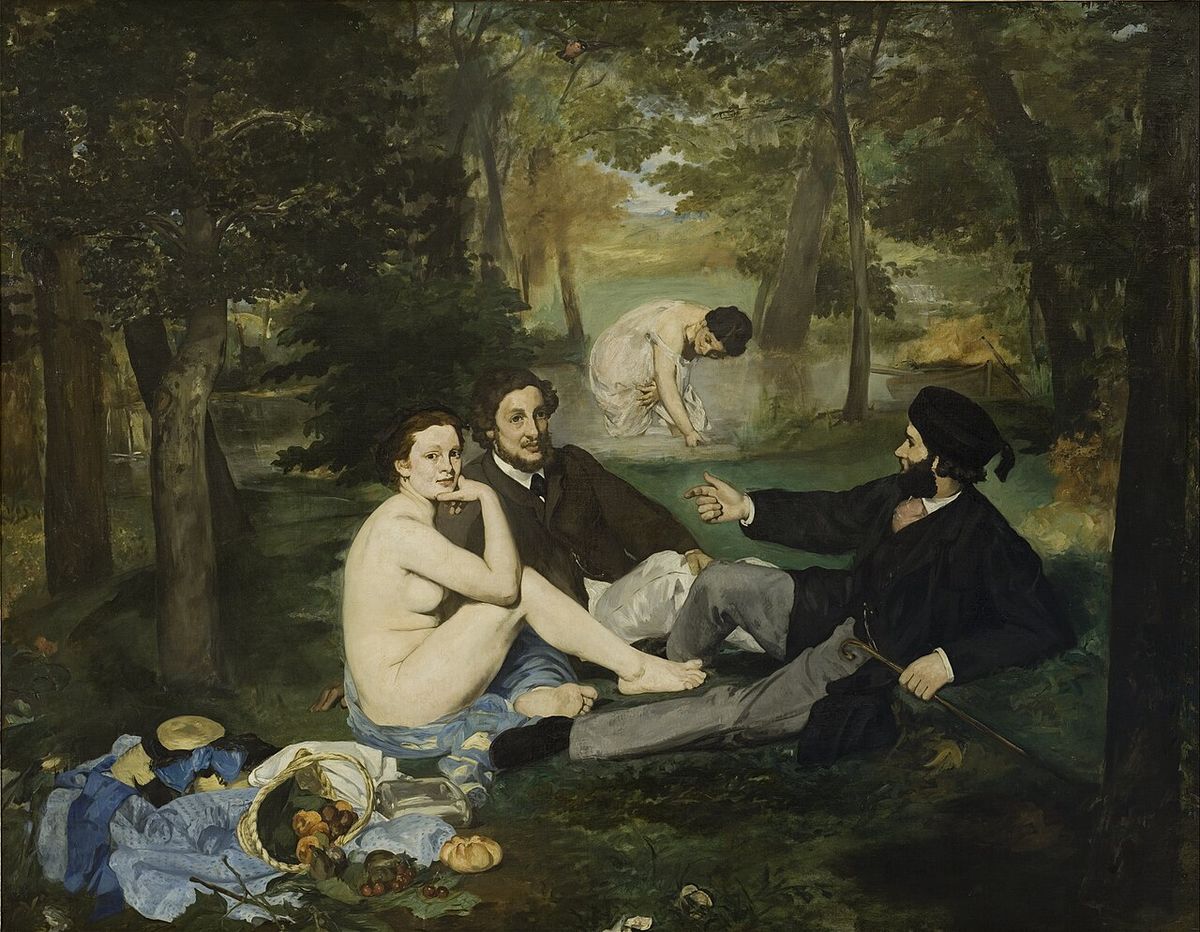
Before 1874, a French painter's career ran through the Salon, the official Paris exhibition, whose jury rewarded polished, idealized work. In the 1860s Courbet, Manet and the young Monet and Bazille challenged that standard, pointing toward the traits of Impressionism: visible brushwork, bright color, outdoor scenes and subjects from modern life. The younger painters' trouble getting a fair hearing at the Salon led to the independent exhibition of 1874.
- A Salon jury chose what was hung, and success brought state purchases, prizes and buyers.
- In 1863 works the jury refused went on view at a separate Salon des Refusés.
- Courbet's Realism and Manet's modern subjects showed that present-day life could fill a large canvas.
- Salon
- The official Paris art exhibition, chosen by a state jury.
- Academic art
- Painting taught by the École des Beaux-Arts: classical subjects, careful drawing, smooth finish.
- Realism
- Courbet's movement, from about 1850, painting present-day life without idealizing it.
Works in this part
- The Birth of Venus
- Woman with a Parrot
- Le Déjeuner sur l'herbe
- Olympia
- A Studio at Les Batignolles
- The Railway
- Garden at Sainte-Adresse
- La Grenouillère
- Family Reunion
Image: Wikimedia Commons · Public domain