Munich
Wassily Kandinsky
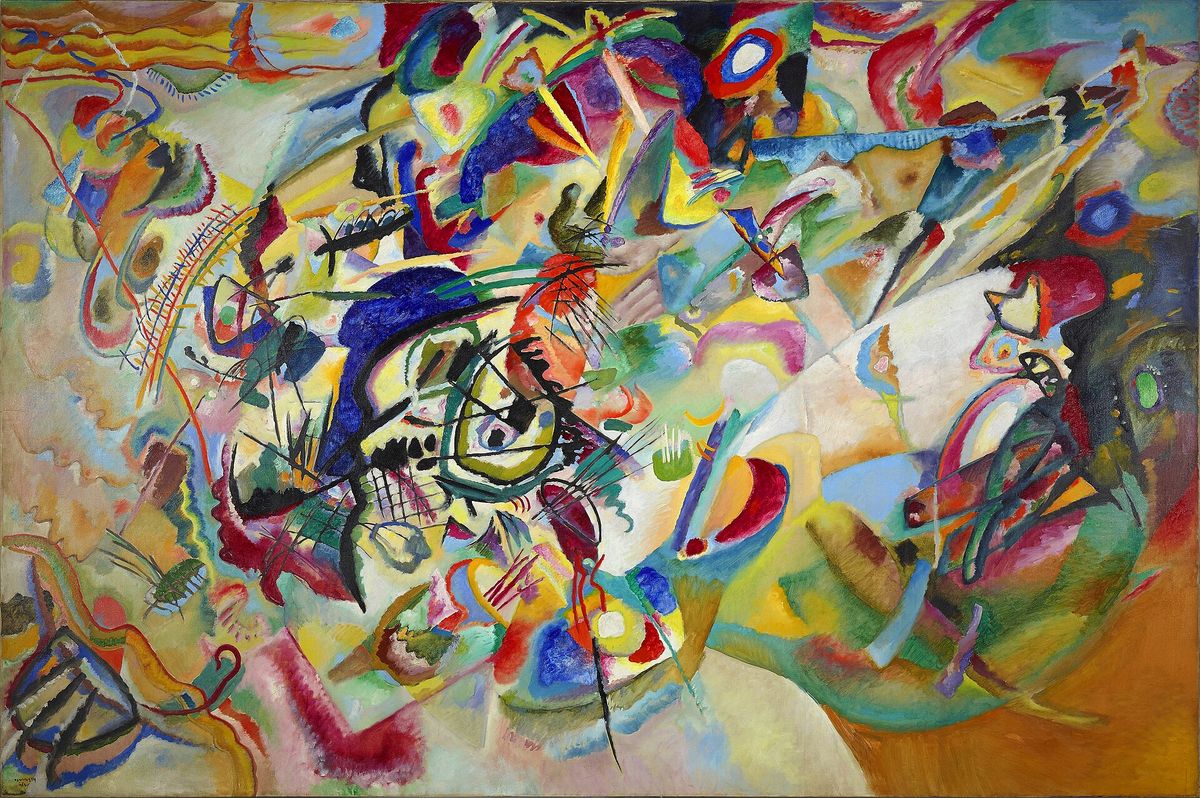
Composition VII
1913
Oil on canvas, about 200 × 300 cm. State Tretyakov Gallery, Moscow
A huge canvas of colliding shapes, lines and colors that swirl around a dark knot left of center. The Tretyakov ranks it with the central works of his early 1910s.
- More than thirty studies came first, in pencil, pen, watercolor and oil, most from autumn 1913.
- Look for faint traces of the end-of-the-world theme of his earlier pictures: angels blowing trumpets and a rider.
- Once the studies were done, the large canvas took only a few days, 25 to 28 November.
- Few recognizable objects remain. The museum's partner text describes blue and red accents on a diagonal, held together by white in many shades.
- It came to the Tretyakov in 1929 from Moscow's State Museum of New Western Art.
- Non-objective (abstract) art
- Art that shows no recognizable objects, using only color, line and shape.
Image: Wikimedia Commons · PD-Art