Revolution and Nightmare
Francisco de Goya
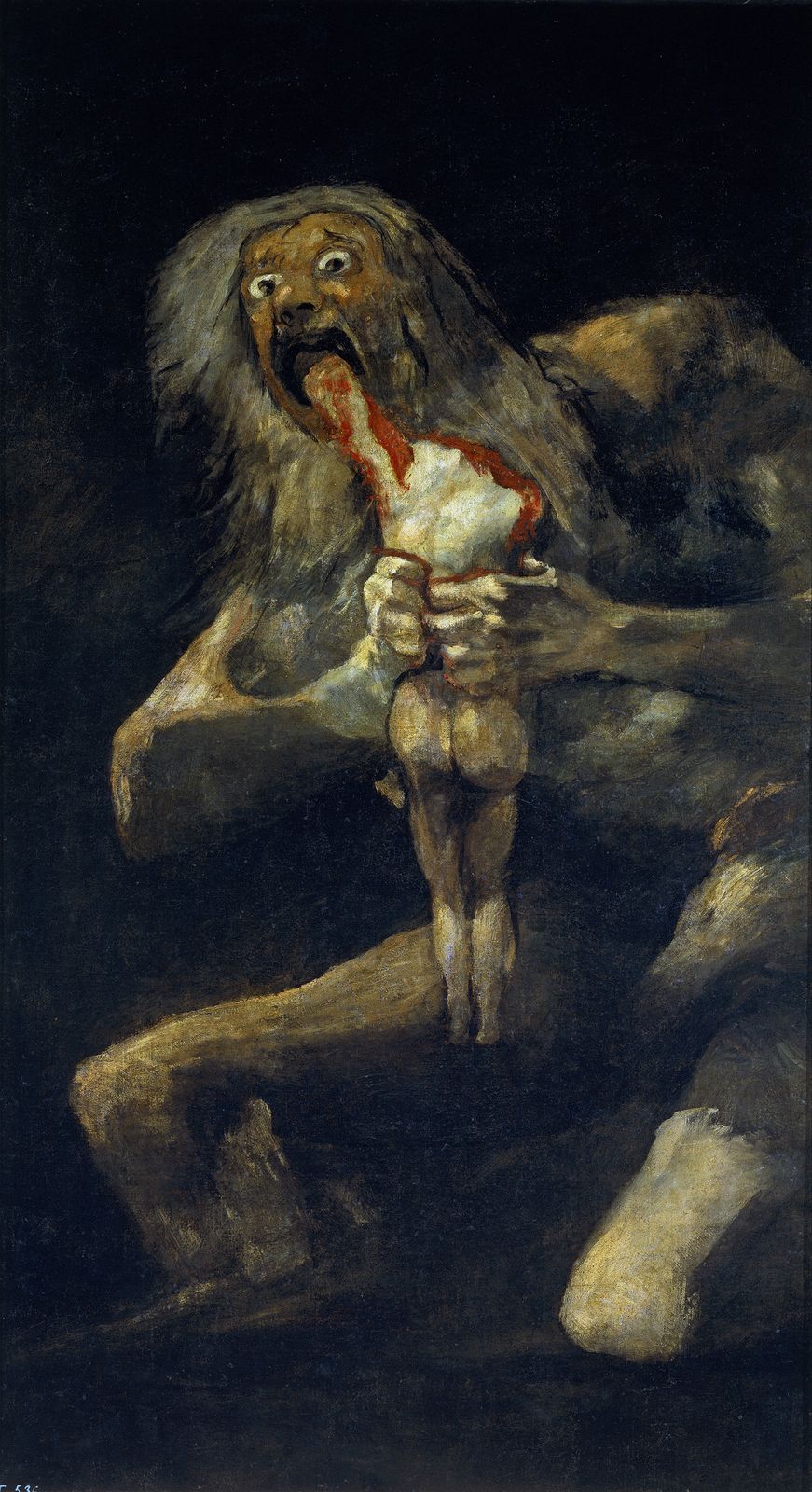
Saturn Devouring His Son
1820–1823
Mixed technique, mural transferred to canvas, 143.5 × 81.4 cm. Museo Nacional del Prado, Madrid
A wild-eyed giant tears at a headless body. The late murals it belongs to shaped the modern image of the artist and, says the Prado, fed into Expressionism, Surrealism and film.
- Placed on the ground floor of the Quinta del Sordo, facing an image of Leocadia Zorrilla.
- Look at the staring eyes and the darkness that swallows everything except the two bodies.
- Chemical analysis found oil in the paint, which is why the Prado calls the technique mixed.
- Made for the house he lived in rather than for a client or a public showing, it is art kept for the artist alone. The Prado suggests the god may stand for the fear of losing power.
- Baron Émile d'Erlanger bought the house in 1873, had the murals moved to canvas at a heavy loss of paint, and gave them to the Spanish state.
- Black Paintings
- The later name for the dark murals painted directly on the walls of the Quinta del Sordo in Madrid, near the end of his life in Spain.
Image: Wikimedia Commons · Public domain (PD-Art)