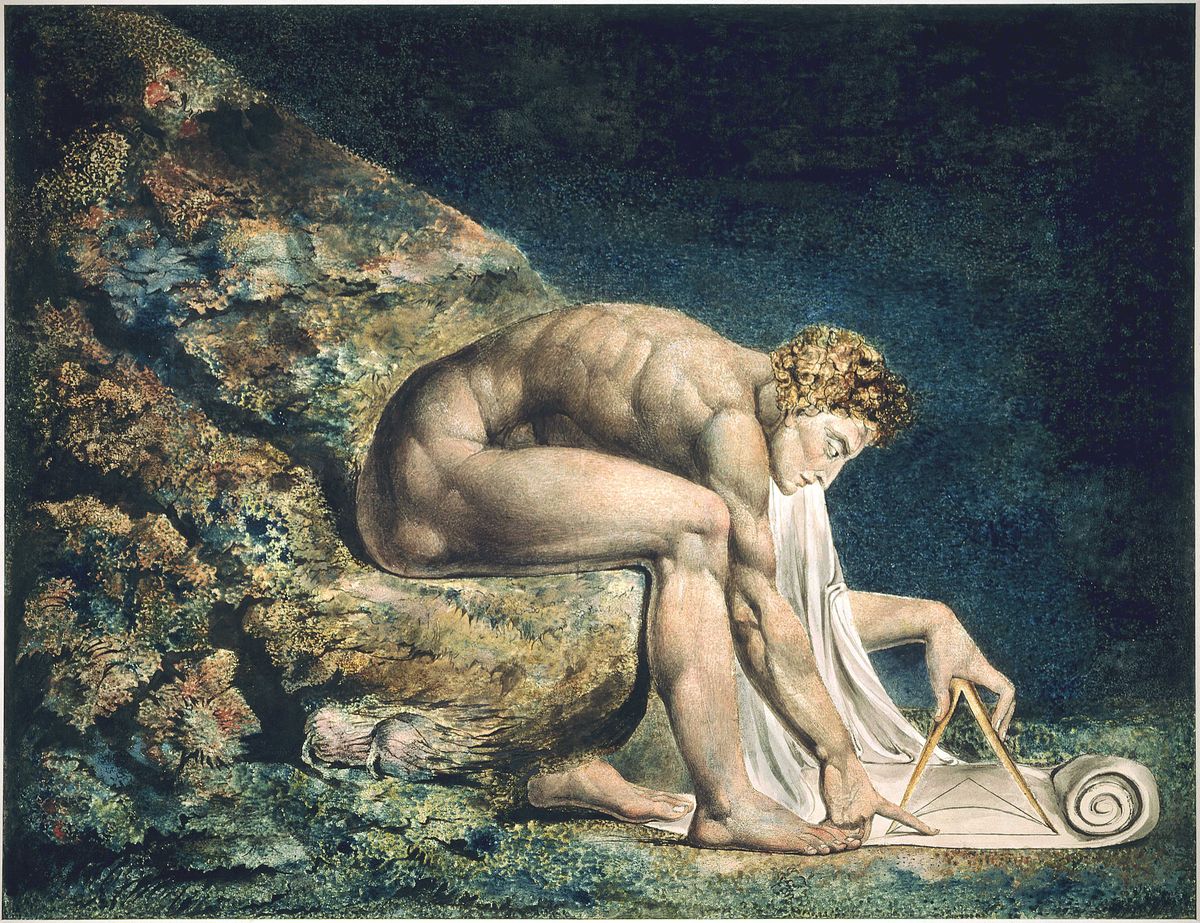
Revolution and Nightmare
William Blake
Newton
1795–c. 1805
Color print, ink and watercolor on paper, 46 × 60 cm. Tate, London
A muscular nude scientist sits hunched on a rock, drawing with compasses on a sheet at his feet. Blake turns the hero of the Enlightenment into a man shut inside his own diagram.
- First shown in public at the Burlington Fine Arts Club, London, in 1876, long after Blake's death.
- Look at the murky green setting and the patterned rock, which the Tate catalogue reads as a scene under water.
- The pose comes from Michelangelo's Abias in the Sistine Chapel, which Blake knew from an engraving.
- Blake's attack on Newton is an early sign of a lasting Romantic distrust of science that reduces the living world to measurement.
- Presented to the Tate by W. Graham Robertson in 1939.
Image: Wikimedia Commons · Public domain (PD-Art)