Gods and stories
Roman, sculptor unknown
Jupiter of Smyrna
2nd century CE
Marble, 270 cm high · Louvre, Paris
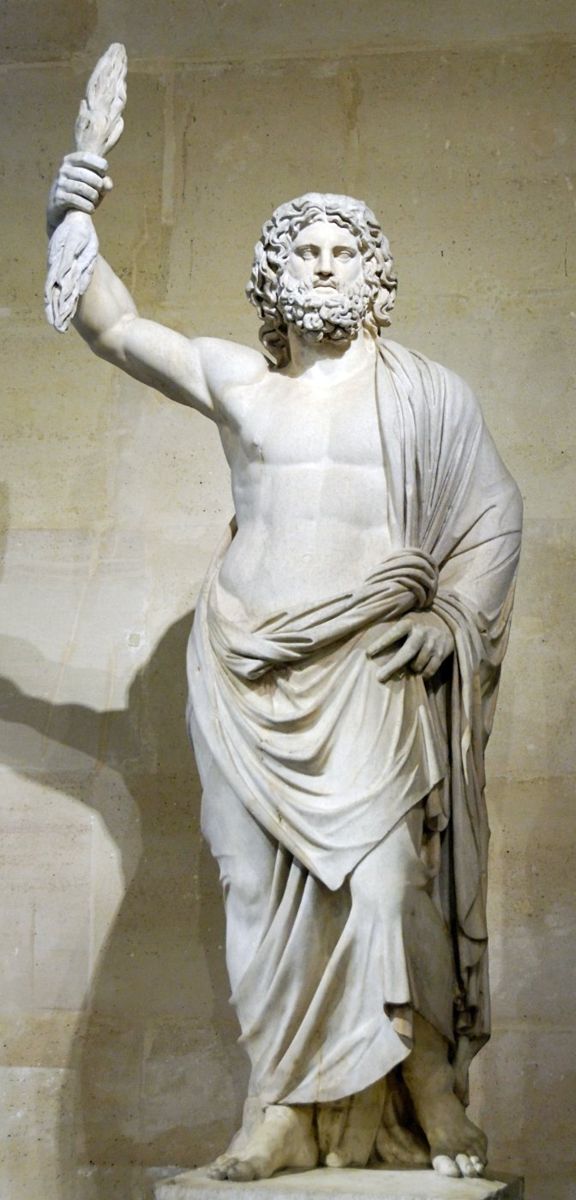
An over-life-size Roman marble of the king of the gods, carved in the province of Asia and possibly copied from a Greek original about three centuries older. Much of what you see was rebuilt for Louis XIV.
- Recorded at Smyrna (modern İzmir) in 1680, owned by a Dutch merchant, and bought for Louis XIV.
- Pierre Granier restored it in 1686: the shoulder, raised arm and thunderbolt, nose, feet and base are his.
- Stood on the Allée Royale at Versailles from 1687; moved to the Louvre after the Revolution.
- Look for the deep drill work in the hair and beard, typical of 2nd-century Roman carving.
- Since the thunderbolt is modern, the Louvre also lists Asclepius, god of healing, as a possible identity.
Zeus (Roman Jupiter) is king of the gods and god of sky and thunder, who took power by overthrowing his father Cronus. Sculptors showed him as a mature, bearded man, bare-chested, with scepter and thunderbolt.
- Himation
- A large rectangular cloak worn by Greek men, here draped to leave the chest bare.
Image: Wikimedia Commons · Public domain